Do I need to register as an importer if I buy personal goods from abroad e.g. from Amazon?

12 June 2024 – No, you don’t have to register as an importer if you meet certain conditions. Personal goods can be cleared with Customs under the generic code 70707070. However, you must meet the following conditions:

  • According to the Legal LSec CE RA Customs and Excise Rules 1995 as amended as published on 12 April 2024 on the Rule Amendments webpage, the allowance has changed from not more than R50 000 (only 3 transactions) to not more than R150 000 (one or more);
  • You are only allowed to import goods for home consumption or personal use, not for resale or any other business;
  • You must be located in South Africa;
  • Your identity number/ Passport number or taxpayer reference number must be entered in the field provided in the declaration form.

Should the purchase falls outside these limitations, you will have to register and obtain an importer or exporter code.

Note that the above clearance process has been in place for a number of years, and it’s only the amount and number of transactions that have changed in April 2024. This ruling is not related to the possibility of adding a tax or duty on parcels of low value e.g. buying clothing from overseas companies as it is merely a discussion at this point and not official.

Source: SARS Tariffs
Do I need to register as an importer if I buy personal goods from abroad e.g. from Amazon?
Removal of eBooking callback option from the USSD Channel

12 June 2024 – The USSD channel is one of the ways SARS engages with taxpayers who might not have internet access or only have a standard mobile phone. The SARS USSD channel involves dialling a service code for SARS. As a response, SARS presents menu options on the mobile device. The fourth menu option on the USSD Channel is the eBooking callback service.

To manage the effect of the number of queries during peak tax seasons while striving for excellence in taxpayer service, a decision was made to remove the eBooking callback as part of the USSD menu option.

Taxpayers who would like to make an appointment are encouraged to:

  • Use the eBooking system
  • Contact SARS directly via the SARS Contact Centre.
  • Send an SMS to request an appointment, follow these easy steps:
    • Send an SMS to SARS on 47277 
    • Add this wording in the SMS: Booking (Space) ID number/Passport number/ Asylum Seeker number

For more information see the Guide to SARS Mobile Tax Services or visit SARS Mobile Tax Services.


Source: SARS Tariffs
Removal of eBooking callback option from the USSD Channel

Maintenance on SARS Third Party Data Submissions Platforms 13 June 2024

11 June 2024 – Please note that the submissions platforms for both Secure File Gateway and Connect:Direct will be temporarily offline for planned maintenance between 16:00 and 21:00 on Thursday 13 June 2024.

Please do not submit any files in the Production or Test environments during this time, as they will not be received or processed. Files already in the system will be paused and will continue processing upon conclusion of the maintenance.

Source: SARS Tariffs
Maintenance on SARS Third Party Data Submissions Platforms 13 June 2024

Scam alert – ‘Outstanding Tax Payment’

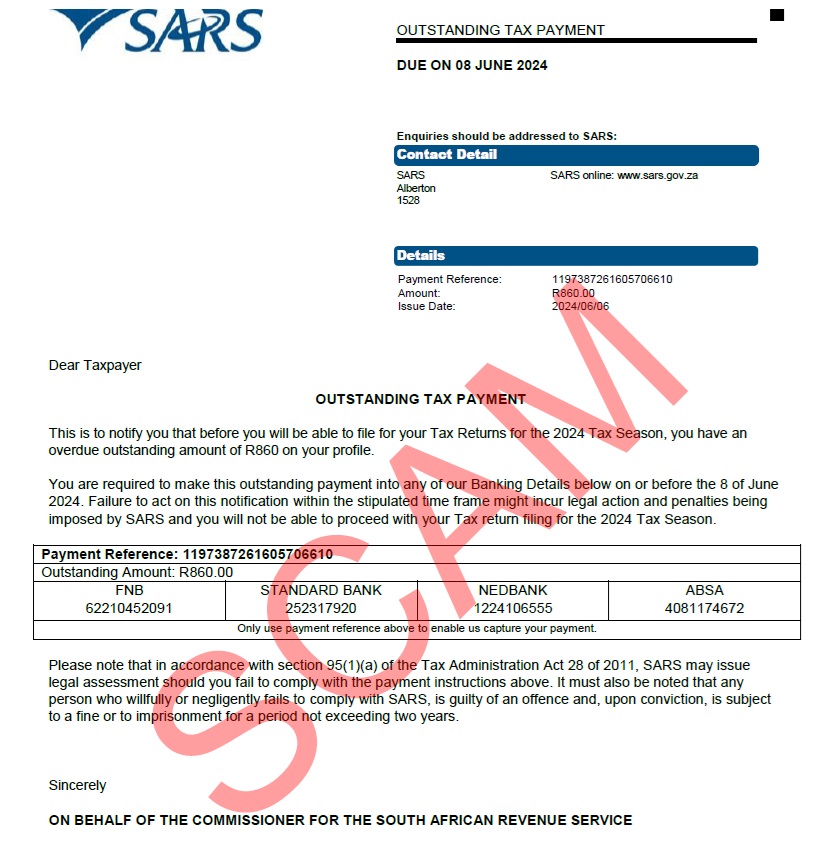
10 June 2024 – A reminder of the scam alert published last week: Fraudsters are posing as SARS, luring taxpayers into a trap. Don’t fall for it! SARS never provides bank account numbers. If you need to make a payment, only use the official SARS payment channels, see the Make a Payment webpage.

The bank accounts used in the scam are fraudulent bank accounts and SARS is following up with the relevant banks and authorities:

An example of the scam has been published on our Scams & Phishing webpage.

Note that the email address the scam is being sent from, is not a SARS email address:

From: South African Revenue Service <payment@sarsmail.one>
Date: 2024/06/06 08:48 (GMT+02:00)
To:
Subject: Notification from SARS

Dear Taxpayer,

An important notification has been issued and is attached to this mail. Please respond or act as stated on the letter.

Source: SARS Tariffs
Scam alert – ‘Outstanding Tax Payment’

Media statement on SHL Wholesalers Tax Case in Court

7 June 2024 — The South African Revenue Service (SARS) confirms that the Gauteng South Regional Division sentenced Suhayle Ballim, the sole member of SHL Wholesalers CC (SHL) to 15 years’ direct imprisonment for defrauding the organisation. Ballim was accused of purportedly exporting goods from the Republic of South Africa to other African countries (ghost exports), which resulted in him and SHL claiming undue Value-Added Tax (VAT). The case took 14 years to finalise in court due to delays caused by Ballim as pointed out by the presiding magistrate.

Ballim and SHL submitted false VAT 201 returns for 39 VAT periods from February 2004 until April 2007, wherein outputs of the declared goods that were purportedly sold to clients in Mozambique and Zimbabwe resulted in a zero-rated supply, which, in turn, resulted in fraudulent VAT refunds totaling R15 607 587.86 being paid by SARS.

The investigation, led by the SARS Criminal Investigation Unit, included search and seizure operations, which were conducted on the business premises and private residence of SHL and Ballim respectively, where false export documents, invoices, delivery notes, road manifests and export bills of entry (DA550) were discovered. Ballim used the proceeds from the fraudulent refunds to maintain his lifestyle as the sole signatory on the banking account of SHL.

SARS Commissioner, Mr Edward Kieswetter, thanked SARS and other law enforcement agencies, including the National Prosecuting Authority and the South African Police Service for their dedication to ensuring that Ballim and SHL were prosecuted for their actions. He said, “The message is loud and clear that SARS will not rest nor tolerate those who indulge in criminality and deprive the country’s fiscus of what is due to it. Taxpayers who live lavish lifestyles, beyond honest means, by stealing from the most vulnerable in society must face the consequences; SARS will make it hard and costly for those who engage in criminality”.

For further information, please contact SARS at SARSMedia@sars.gov.za.

Source: SARS Tariffs
Media statement on SHL Wholesalers Tax Case in Court

Third Party Data – Changes in SARS medical aid data reporting

7 June 2024 SARS has recognised the challenges faced by taxpayers in submitting medical aid data accurately and on time. To simplify this process and reduce the burden on taxpayers, SARS is making changes on the data that is required from medical aid schemes.

The changes include:

  • Provision of data on disabled Principal members and their dependents
  • Data of persons making payment on behalf of principal members.
  • Separate non-allowable from the allowable expenses, currently reported as claims not paid or covered by medical schemes on the IT3(f) certificate.
  • Field 4, File Layout Version must be 3.
  • For inclusivity of disabled taxpayers with multiple disabilities, the Principal Member and Dependent Disability Information containers in the Medical Scheme Contributions external BRS (Version 1.07) have been expanded to allow the selection of multiple disabilities. For ease of reference, the changes in the latest BRS (Version 1.08) are as follows:
    • Under the Principal Member Disability Information record, fields 261 to 265 have been added and field 191 has been amended
    • Additionally, the Dependent Disability Information record has additional fields from 266 to 270 and field 216 has been amended.

These changes will also allow SARS to reduce audit interventions, and enable speedy assessment of tax returns, and assist in allocating medical tax credits to the correct taxpayers. Effective September 2024, medical aids are expected to provide the requested data in line with the conditions outlined in the external Medical Scheme Contributions Business Requirement Specification (BRS).

The Medical Aid updated solution will be availed via Connect: Direct® and Secured File Gateway [HTTPS] for Trade Testing from 12 August to 06 September 2024, refer trade testing queries to Bus_Sys_CDSupport@sars.gov.za with the subject Medical Trade Testing.

To allow for a smooth transition, SARS will grant a grace period of 6 months for partial submission of the requested data while stakeholders attain resources that consent to full compliance. Where such cases of partial compliance occur, reasons and a commitment date for full compliance will be required.

For more information.  please see the Third Party Data Submission Platform webpage.

Source: SARS Tariffs
Third Party Data – Changes in SARS medical aid data reporting

Guide on access to audit files

Summary

The purpose of this Webpage is to assist taxpayers and their statutory auditors in understanding their rights and obligations in relation to SARS requesting access to the audit files.

Introduction

  • In 1998, the South African Institute of Chartered Accountants (SAICA) issued a Circular Minute 5/98 which stipulated the procedures agreed with SARS when requesting access to audit workings. This Circular was subsequently withdrawn.
  • The Independent Regulatory Board for Auditors (IRBA) published a guide on “Access to Audit Working Papers” in October 2010 after consulting with SARS. This IRBA Guide was compiled before the promulgation of the Tax Administration Act, No. 28 of 2011 (TAA) and is therefore outdated.
  • The concern has been raised with SARS that the calling for audit files should not be a routine request during every tax audit as this could inhibit frank and open discussions between the client and its statutory auditor.
  • It is not the intention of SARS to place strain on the relationship between the taxpayer and its auditor, therefore it is considered necessary to provide assurance and guidance on this subject.

Why would SARS call for Audit Files

Statutory Audit vs Tax Audit:

  • The aim of a statutory audit is to express an opinion on the financial statements as a whole. The opinion only provides reasonable assurance and is issued for the use of all interested parties, including SARS.     
  • The aim of a tax audit is to determine if the taxpayer has complied with the relevant legislation administered by SARS. The tax auditor does not express an opinion, but rather makes a determination as to the correctness of a declaration.  These tax audits are normally based on risk(s) identified in a specific declaration made by a taxpayer.  The financial statements are an important source of supporting evidence for declarations made by taxpayers. 
  • Despite the different objectives of statutory auditors and tax auditors, both audits should be of a high standard and be conducted effectively and efficiently. In both audits sufficient and appropriate audit evidence must be gathered to support the opinion/determination of the auditor.

SARS’S Mandate:

  • The aim of a tax audit is to determine if the taxpayer i.e. the client of the statutory auditor has complied with the relevant tax/customs legislation. The tax auditor does not determine if the audit work done by the statutory auditor is sufficient, correct or whether the statutory auditor came to the correct conclusion.
  • In terms of section 46 of the TAA, SARS can only request relevant material i.e. access to audit files, for purposes of the administration of a tax Act.
  • In the process of administration of a tax Act, SARS may consider it necessary to gain an understanding of the taxpayer’s operating environment in order to focus its audit efforts. This can be obtained from the audit file of the statutory auditor.
  • Furthermore, in circumstances where the taxpayer’s declaration is incomplete or insufficient, or the taxpayer or independent third parties are unable to provide SARS with the information required, access to the statutory auditor’s audit file could be considered necessary in order to ensure sufficient and appropriate audit evidence is gathered to support the assessment by the tax auditor.
  • Lastly, in instances where the taxpayer withholds information, SARS might deem it necessary to obtain the information it needs from the statutory auditor’s audit file.
  • It is not SARS’s mandate to investigate whether statutory auditors have adhered to the IRBA Code of Professional Conduct of Registered Auditors or the Auditing Profession Act, 2005. That is the role of IRBA.  Therefore it would never be SARS’s intention to request access to the statutory auditor’s audit files in order to discredit the statutory auditor.  Such a request would not be for the purposes of administration of a tax Act, and would therefore be unlawful.
  • However in terms of section 241 of the TAA, if an intentional or negligent act of a person governed by controlling body, results in a taxpayer avoiding or unduly postponing performing an obligation contained in a tax Act, SARS may report that person to the controlling body. In addition, if a person governed by a controlling body conducts himself/herself in a manner that exposes the professional to disciplinary action being taken by the controlling body, SARS may report that professional to the controlling body.

The Right of SARS to call for Audit Files

  • In terms of section 46 of the TAA, SARS may for the purposes of administration of a tax Act, require the taxpayer or another person to submit relevant material within a reasonable period. Relevant material includes information, documents or things that in the opinion of SARS are foreseeably relevant for the administration of a tax Act.  As explained above, access to the audit file of the statutory auditor would only be requested where it is considered necessary for purposes of administration of a tax Act.
  • There is no general restriction on SARS requiring information contained in an audit file. However SARS respects the unique relationship between the taxpayer and its statutory auditors; and therefore undertakes not to call for audit files as a matter of routine or without obtaining approval from a senior official.  Policies and procedures have been put in place within SARS to govern such requests.  Any concerns with such a request should be taken up with the senior management at SARS, who would have had approved the request.        
  • It is a criminal offence to refuse or neglect to supply relevant material requested by SARS without just cause.
  • Legal professional privilege does not apply to statutory auditors.
  • This Guide does not apply if SARS conducts an inquiry or a search and seizure.

What can the Taxpayer/Statutory Auditor Expect when Audit Files are Called for

When can the Audit files be called for?

  • The circumstances and facts of each case will be considered before making a request for access to audit files.
  • SARS will generally exhaust all options to request relevant material from the taxpayer directly. However, SARS is not precluded from requesting the same relevant material from the statutory auditor.

How will the Audit files be Requested?

  • SARS will give notice to the statutory auditor in writing of a request to access the audit files and SARS will give a reasonable time within which such information should be submitted.
  • Any request for access to audit files will be subject to approval by a senior official.

Confidentiality

  • There is a general duty on current and ex SARS employees and every person contracted by SARS, to preserve the secrecy of taxpayer information and not to disclose taxpayer information to a person who is not a SARS official. All SARS officials, including persons contracted by SARS, are obliged to take an oath of secrecy. 
  • The consequences of contravening the secrecy provisions are severe, as any disclosure by a SARS official contrary to the secrecy provisions would be unlawful. The official could be liable for criminal prosecution as well as civil action against him/her and SARS. 
  • The duty to preserve secrecy of taxpayer information does not prohibit a SARS official from disclosing taxpayer information when required by specific legislation.

How are Audit Files made Available?

  • The audit files can be made available as follows:
    • Make the original audit files available for inspection;
    • Provide copies of the audit files to SARS;
    • Provide the audit files in electronic format;
    • Other
  • Where the original audit files are made available for inspection at premises outside of SARS, then:
    • The SARS tax auditors must produce identity cards. The identity of the SARS tax auditor can be verified by contacting the telephone number provided on the card.
    • Where the SARS tax auditor makes photocopies, the photocopy cost can be recovered from SARS.
  • Where copies of the audit files are made available, these can either be delivered to the SARS tax auditor or arrangements can be made with the SARS tax auditor to collect them.
  • Where the audit files are made available in electronic format:
    • The SARS tax auditor can view such electronic audit files at the premises of the taxpayer/statutory auditor on computer(s) provided by the taxpayer/statutory auditor provided that the computer(s) made available have the necessary software installed to enable the viewing of the electronic file;
    • Where it is considered necessary to obtain downloads of the electronic audit files, the SARS tax auditor will make prior arrangement with the statutory auditor and a specialist with the required computer skills from SARS will assist with obtaining the download.
  • Any other means of making the audit files available can be done by arrangement with the relevant SARS official.

Right of the Taxpayer/Statutory Auditor when Audit files are Called for

  • The statutory auditor has the right to inform the taxpayer of the request received from SARS.
  • Where the client of the statutory auditor claims legal professional privilege over certain documents, the statutory auditor can remove such documents but must inform SARS accordingly. SARS will then follow the prescribed process as per section 42A of the TAA where SARS disagrees with the existence of legal professional privilege.
  • The TAA requires that the records, books of account or documents relevant to the audit must be retained until the audit, objection or appeal is finalised.

Definitions, acronyms and abbreviations

The definitions, acronyms and abbreviations can be accessed here – Glossary webpage.

Legal disclaimer: In the event of conflict or inconsistency between this webpage and the PDF version of the guide, the latter shall prevail.

Source: SARS Tariffs
Guide on access to audit files

Dispute Resolution for Trusts: Enhancements

7 June 2024 – A reminder of the automated process for Trust taxpayers that was introduced on eFiling during April 2024 to electronically submit documentation to lodge a dispute via a fully guided process. This applies to the following transactions:

  • Submission of Request for Reasons,
  • Request for Remission (RFR),
  • Notice of Objection, and Notice of Appeal.

Note: A request for suspension of payment currently remains a manual process using the steps provided below.

Prior to this enhancement, the Trust dispute process was a fully manual process, using the ADR1 and ADR2 forms (Alternative Dispute Resolution forms).

Process for Suspension of Payment

The suspension of payment currently remains a manual process and requires one of the following:

  • Submission of uploading a formal request letter (requesting the suspension of payment) when lodging a dispute on eFiling, together with other supporting documentation
  • Submission of a formal request letter at SARS a branch

Important note: Trusts that submitted any of the processes mentioned above before 20 April 2024 should still conclude their dispute through the manual process.

Source: SARS Tariffs
Dispute Resolution for Trusts: Enhancements